

How to Measure Neck, Waist & Hips (The Right Way)
Follow clear instructions for measuring your neck, waist and hips for body-fat calculators, clothing sizes and body-composition tracking.
Key Takeaways & Summary
Follow clear instructions for measuring your neck, waist and hips for body-fat calculators, clothing sizes and body-composition tracking.
US Navy Body Fat Calculator & Formula
Estimate body fat percentage and lean mass using neck, waist, and hip circumference.
Measuring your neck, waist, and hips correctly matters because the results go directly into body-fat formulas and health-risk assessments. A misplaced tape or a pulled breath can shift the outcome by enough to change how you interpret your progress. For a broader look at what those numbers mean once you have them, see the body fat percentage guide.
If “how to measure waist correctly” brought you here, start with practical steps.
The goal is not perfect precision. The goal is consistency. If you measure slightly differently each time, you lose the ability to see real trends. Here is how to get it right.
What You Need
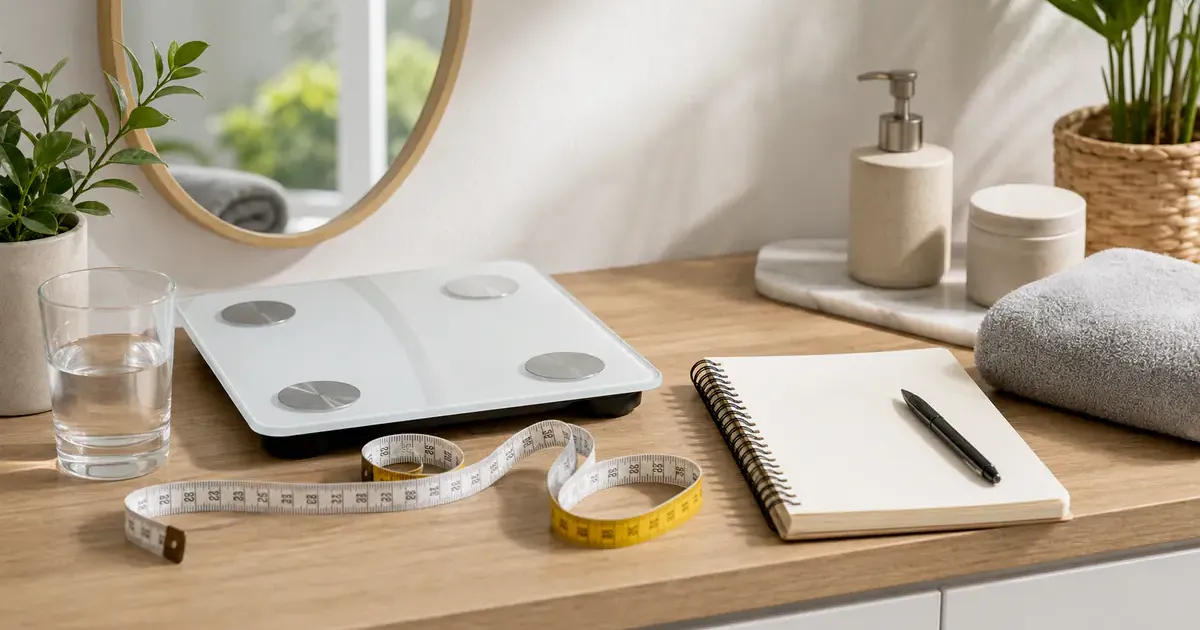
A flexible, non-stretch measuring tape is the only essential tool. Cloth or fibreglass tapes work well. Metal tapes do not. Paper tapes stretch over time and should be replaced.
You will also benefit from a mirror to check tape placement, a notebook or app to record your numbers, and in some cases, another person to help with measurements that are hard to reach.
General Measurement Rules
These apply to every site you measure.
- Keep the tape level and parallel to the floor.
- Do not compress the skin. The tape should rest against the body without leaving an indent.
- Stand in a relaxed, natural posture.
- Breathe normally. Do not hold your breath or suck in your stomach.
- Measure directly on skin or against thin, tight clothing. Bulky clothing adds thickness that changes the reading.
- Take each measurement twice. If the two readings differ by more than about half a centimetre, measure a third time and take the average of the closest two.
- Record the exact location you used, especially for the waist. This matters more than most people realize.
How to Measure Your Neck
For most body-fat formulas, the neck is measured at or just below the larynx.
Stand straight with your head in a neutral position—do not tilt your chin up or down. Place the tape around the neck at the height where it feels natural, just below the Adam’s apple for men. The tape should slope slightly downward at the front and remain level at the back.
Keep the tape flat against the skin without pressing into it. If you pull the tape tight enough to compress the tissue, the reading will be smaller than it should be.
For the Navy method specifically, men measure the neck below the larynx. Women measure at the same location. The neck measurement is used in combination with the waist (and hips for women) to estimate body fat. It is not a standalone measure.
Common mistakes include measuring too high on the neck, tilting the head, and pulling the tape so tight that it leaves a mark.
How to Measure a Man’s Waist for the Navy Formula
For the US Navy method, men measure the waist at the level of the navel.
Stand upright with the abdomen relaxed. Do not suck in. Place the tape around the waist at navel height, making sure it is level all the way around. Breathe out gently and take the measurement at the end of the exhalation.
The tape should sit against the skin without compression. If you are measuring over clothing, use thin clothing and make sure nothing adds bulk at the waist.
How to Measure a Woman’s Waist
This is where instructions vary between methods. Some body-fat formulas use the natural waist—the narrowest point between the bottom of the ribs and the top of the hip bones. Others use the navel level, consistent with the Navy method for men.
The safest approach is to follow the instructions of the specific calculator you are using. If you are using the Navy Body Fat Calculator, use the navel-level measurement. If the instructions on another calculator say “measure at the narrowest point,” use the natural waist.
What matters most is that you use the same location every time. Swapping between natural waist and navel-level measurements will produce inconsistent trends.
How to Measure the Hips
Hip measurement for body-fat formulas is taken at the widest point of the hips and buttocks.
Stand with your feet together. Place the tape around the widest part of your hips—usually at the level of the greatest protrusion of the buttocks. The tape should be parallel to the floor.
A mirror or a second person helps here, because it is easy to let the tape drift upward at the back. If the back of the tape is higher than the front, the measurement will be off.
Common mistakes include measuring too high (at the hip bones rather than the widest point), keeping feet apart, and letting the tape sag at the back.
Natural Waist vs Navel Measurement
| Location | Where to Measure | Used By | Notes |
|---|---|---|---|
| Natural waist | Narrowest point between ribs and hips | Some body-fat formulas, waist-to-height ratio | Easier to find on people with a defined waist |
| Navel level | Around the abdomen at the belly button | Navy method, some health-risk assessments | More consistent landmark for self-measurement |
If your calculator asks for one, use that one. If it does not specify, use navel level for Navy-based estimates and natural waist for waist-to-height ratio.
How Tight Should the Tape Be?
Tight enough to stay in place without sliding down. Loose enough that you can slide one finger between the tape and your skin without force.
If the tape leaves a visible indent after you remove it, it was too tight. If it shifts when you move, it was too loose.
When Should You Take Measurements?
Consistency of conditions matters more than the absolute time of day.
- Measure at roughly the same time of day each time.
- Avoid measuring right after a large meal.
- Avoid measuring immediately after a workout, when blood flow and hydration are shifted.
- For women, bloating related to the menstrual cycle can affect waist circumference. This is normal variation, not a reason to stop measuring—just note it.
How to Improve Measurement Reliability
- Take two or three measurements per session. Use the average.
- Use the same measuring tape. Tapes can stretch or differ between manufacturers.
- Mark the anatomical landmarks you use. If you measured your waist at a certain spot, remember where that was.
- Record the date and the method used alongside the number.
- If you switch methods or formulas, start a new trend line. Do not blend old and new data.
Common Measurement Mistakes
- Slanted tape that is higher at the back than the front.
- Sucking in the stomach during waist measurement.
- Compressing the skin with the tape.
- Measuring over thick clothing or a belt.
- Using a different waist position each time.
- Converting inches to centimetres incorrectly.
- Measuring immediately after a workout.
- Assuming “hips” means the hip bones. For body-fat formulas, hip measurement includes the widest part of the buttocks.
- Taking only one reading and treating it as exact.
Ten seconds of technique saves months of confusion
Waist: at the navel, tape parallel to the floor, exhale normally, no sucking in — you’re measuring a body, not auditioning. Neck: just below the Adam’s apple, tape snug but not strangling. Hips: the widest point around the glutes, feet together. Every reading: morning, before food, after the washroom, same day of the week. Written down — the phone note outperforms memory by embarrassing margins. Bad measurement technique has convinced more people their plan “stopped working” than any actual plateau; a centimetre of tape drift is a month of imaginary failure.
Revisit “how to measure waist correctly” when new data arrives.
FAQ
Where exactly is the natural waist?
Bend to one side. The crease that forms is approximately your natural waist. It is the narrowest part of your torso between the ribs and hips.
Should I measure my waist at the belly button?
For the Navy method, yes. For waist-to-height ratio, use the natural waist. Follow the instructions of whatever tool you are using.
How tight should the measuring tape be?
Firm enough not to slide, loose enough that you can fit one finger between the tape and your skin without force.
Should I measure over clothes?
For best accuracy, measure directly on skin. If that is not practical, wear thin, tight clothing and note that in your records.
Why do body-fat calculators need the neck measurement?
The neck circumference helps the formula account for upper-body frame size. A larger neck changes the estimate because it reflects skeletal structure and muscle, not just fat.
Where is the widest point of the hips?
The widest point of the gluteal muscles, usually at the level of the greatest protrusion of the buttocks. This is not the same as the hip bones.
Should I inhale or exhale while measuring?
Exhale normally and measure at the end of the exhalation. Do not hold your breath or force air out.
How many times should I measure?
At least twice. If the readings differ significantly, measure a third time and average the two closest values.
Can I measure myself accurately?
Yes, for most sites. The neck and waist are easy to self-measure. The hips benefit from a mirror or a second person to ensure the tape stays level.
Why did my waist measurement change in one day?
Daily fluctuations from food, digestion, hydration, and bloating are normal. A change of one to two centimetres in either direction is not cause for concern. Watch the trend over weeks, not the day-to-day number.
This article is for general educational purposes only. Body-composition estimates do not diagnose health conditions or replace individualized advice from a qualified healthcare professional.