

Home Workout Guide for Beginners: No Equipment Needed
A beginner-friendly home workout plan you can do without equipment, with simple progressions, warm-ups, and realistic nutrition notes.
Key Takeaways & Summary
A beginner-friendly home workout plan you can do without equipment, with simple progressions, warm-ups, and realistic nutrition notes.
Starting from zero can feel awkward. Social media makes it look like you need a gym membership, machines, supplements, and a perfect diet before you can begin. You do not. A useful beginner workout can start in your room with a little floor space and a plan you can repeat.
For “home workout for beginners,” perfection is unnecessary. Make the next decision easier.
This guide is specifically designed for people taking their first steps into the fitness world. It focuses on simple movement standards, realistic progressions, and a routine you can repeat without equipment.
The Science of Bodyweight Training
Many people believe that building muscle or losing fat without lifting weights is impossible. Science says otherwise. Bodyweight training, also called calisthenics, is a form of resistance training where you use gravity and your own body weight to challenge your muscles.
When you do a push-up or squat, your muscles don’t know where the resistance is coming from—whether it’s a 10kg dumbbell or your own body. Muscles only recognize tension. If the tension is sufficient, both muscle growth and fat loss will occur. Research shows that for beginners, bodyweight exercises are highly effective for building strength, endurance, and flexibility.
Creating Your Home Workout Space
You don’t need a large gym to work out. A small corner of your home is enough. First, choose a space where you can move your arms and legs freely without obstruction. This could be your bedroom, living room, or balcony.
Keep this space free from distractions. During your workout, put your phone away or set it to “Do Not Disturb” mode. If you have a yoga mat, great. Otherwise, a carpet or rug will work fine. The budget-friendly approach means using what you already have at home.
The 20-Minute No Equipment Routine
This routine is time-saving and highly effective. You can do it 3-4 times per week. It’s a full-body workout that targets all your major muscle groups.
Warm-Up (3 Minutes)
Never skip the warm-up. It increases blood flow to your muscles and prevents injury.
- Jumping Jacks (30 seconds): Great for raising your heart rate.
- Arm Circles (30 seconds): Loosens up your shoulders.
- High Knees (30 seconds): Activates your legs and core.
- Bodyweight Squats (10 reps): Warms up your legs.
The Main Circuit (15 Minutes)
Repeat this circuit 3 times. Rest for 15 seconds between exercises and 1 minute between rounds.
1. Bodyweight Squats (15 Reps) Squats are the king of lower body strength. Keep your feet shoulder-width apart. Keeping your back straight, lower yourself as if sitting in a chair.
2. Incline Push-Ups (10-12 Reps) If regular push-ups feel too difficult, start with incline push-ups. Place your hands on a bed, sofa, or sturdy chair and do a push-up. This targets your chest, shoulders, and triceps.
3. Glute Bridges (15 Reps) Lie on the ground, bend your knees, and keep your feet flat on the floor. Lift your hips until your body forms a straight line. This is excellent for your glutes and lower back.
4. Plank (30 Seconds) The plank is the best exercise for core strength. Balance on your elbows and toes. Keep your body in a straight line and engage your core.
5. Lunges (10 Reps Each Leg) Step forward with one leg, lowering your hips until both knees are bent at 90 degrees. Push back to the starting position. This works your quads, glutes, and hamstrings.
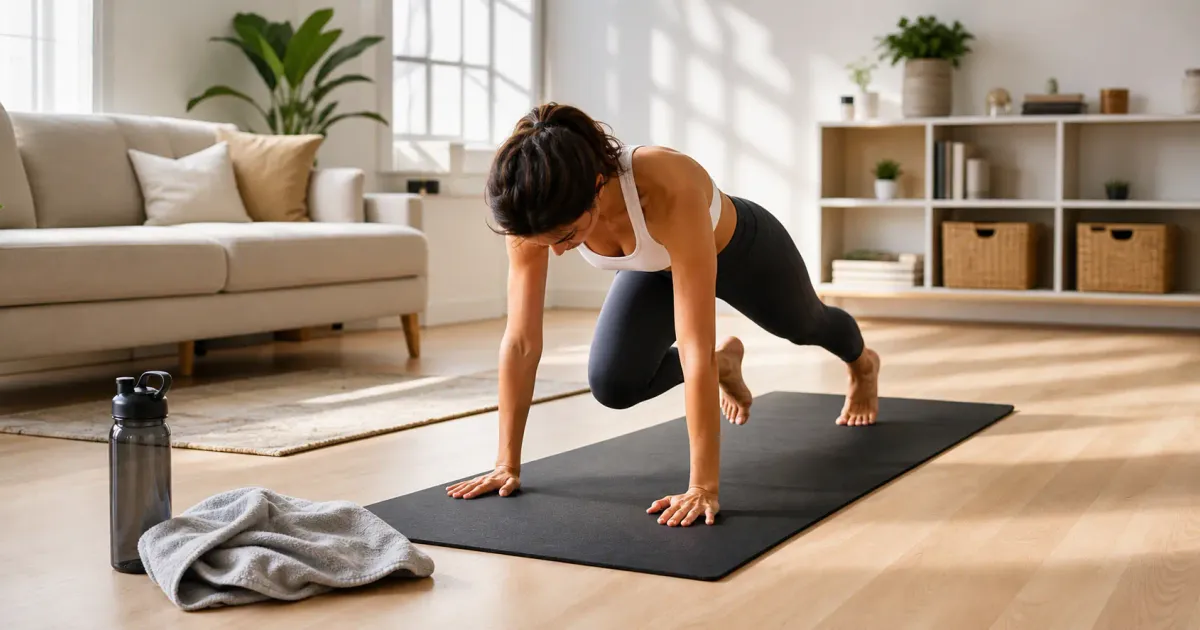
6. Mountain Climbers (20 Reps) Start in a push-up position. Bring one knee toward your chest, then quickly switch legs. This is a great cardio exercise that also works your core.
Cool-Down (2 Minutes)
- Hamstring Stretch (30 seconds each leg): Sit and reach toward your toes.
- Chest Stretch (30 seconds): Pull one arm across your chest.
- Quad Stretch (30 seconds each leg): Pull your foot toward your glutes.
Optional 24-Minute Cardio Circuit
On a separate day, or when you want a cardio-focused session, complete four rounds of the circuit below. Work for 45 seconds, transition for 15 seconds, and rest for one minute after each round.
- Jumping jacks or low-impact step jacks
- High knees or fast marching
- Burpees or an elevated walk-out using a sofa
- Mountain climbers or slow standing knee drives
- Squat jumps or controlled bodyweight squats
Beginners can start with two rounds. Use the talk test: breathing should be challenging, but you should still manage a short sentence. Choose the quiet, low-impact options if jumping bothers your joints or you share walls and floors with other people.
Do this cardio circuit two or three times per week at first and leave recovery time between harder sessions. Sweat alone does not measure workout quality; consistent effort and recovery matter more.
Progressive Overload: The Key to Results
The biggest mistake beginners make is doing the same workout with the same intensity week after week. Your muscles adapt quickly. To continue making progress, you need to gradually increase the difficulty. This is called “progressive overload.”
Here are ways to make your workouts harder:
- Increase Reps: If you’re doing 10 push-ups, try 12 next week.
- Decrease Rest Time: Instead of resting 15 seconds between exercises, rest only 10 seconds.
- Add More Sets: Instead of 3 rounds, do 4.
- Increase Time Under Tension: Do each exercise more slowly.
- Add Variations: Move from incline push-ups to regular push-ups.
The room test
Before you start, check whether the workout fits your real space:
| Exercise | Space needed | Easy swap if space is tight |
|---|---|---|
| Squat | Standing room | Sit-to-stand from a chair |
| Incline push-up | Bed, table or sofa edge | Wall push-up |
| Glute bridge | Floor or mat | Hip hinge practice |
| Plank | Floor or mat | Elevated plank on sofa |
| Lunge | One long step | Split squat holding a wall |
This makes the plan more practical than a generic list of exercises. If the routine requires space you do not have, you will skip it.
Nutrition: You Can’t Out-Exercise a Bad Diet
Even with the best workout routine, you won’t see results without proper nutrition. Here’s a simple rule: you need to eat fewer calories than you burn to lose fat, and you need to eat enough protein to build muscle.
Daily Protein Target: Many beginners do well by first hitting a realistic protein target, not a perfect one. Use the Protein Calculator and the proteinmaxxing guide if you need a range.
Calorie Deficit: For fat loss, use a moderate deficit rather than crash dieting. The Calorie Deficit Calculator can give you a starting estimate.
Meal Timing: While meal timing isn’t as important as total daily calories, eating a meal with protein and carbs within 2 hours after your workout can help with recovery.
Common Mistakes to Avoid
- Skipping Warm-Ups: This increases your injury risk significantly.
- Not Progressing: If you do the same workout forever, you’ll stop seeing results.
- Inconsistency: Working out once a week won’t give you results. Consistency is key.
- Ignoring Nutrition: You can’t out-exercise a bad diet.
- Comparing Your Week 1 to Someone Else’s Year 3: Their routine is not your starting point.
Where home training honestly tops out — and why that’s fine
Bodyweight training carries most people 6-12 months before progress needs outside help — slower tempos, single-leg versions, and rep climbs keep the stimulus honest that long. Past that, legs and back outgrow bodyweight before chest and core do; a single pair of adjustable dumbbells extends the runway by a year. But the real message is the other direction: the person doing 25 home minutes daily out-progresses the member who visits a gym four times a month. The equipment was never the bottleneck. The calendar was.
Apply the “home workout for beginners” principle.