

Beginner Home Workout Plan: 30 Minutes a Day, No Gym Needed
A simple beginner home workout plan for people who want to start fitness without a gym, expensive equipment, or a complicated schedule.
Key Takeaways & Summary
A simple beginner home workout plan for people who want to start fitness without a gym, expensive equipment, or a complicated schedule.
Starting fitness does not have to mean buying equipment, joining a gym, or following a plan made for athletes. For most beginners, the better first step is a routine that is easy to repeat on normal days.
People researching “beginner home workout plan” need a testable baseline. Skip rigid rules.
This plan is built around three goals: move your body, build basic strength, and make the habit feel realistic. You can do it at home with bodyweight exercises and a little floor space.
The 30-minute structure
Use this simple format:
- 5 minutes warm-up
- 20 minutes main workout
- 5 minutes cool-down
The warm-up can be marching in place, arm circles, bodyweight good mornings, and easy squats. The cool-down can be slow walking, light stretching, and deep breathing.
Day 1: Full body basics
- Bodyweight squats: 3 sets of 10
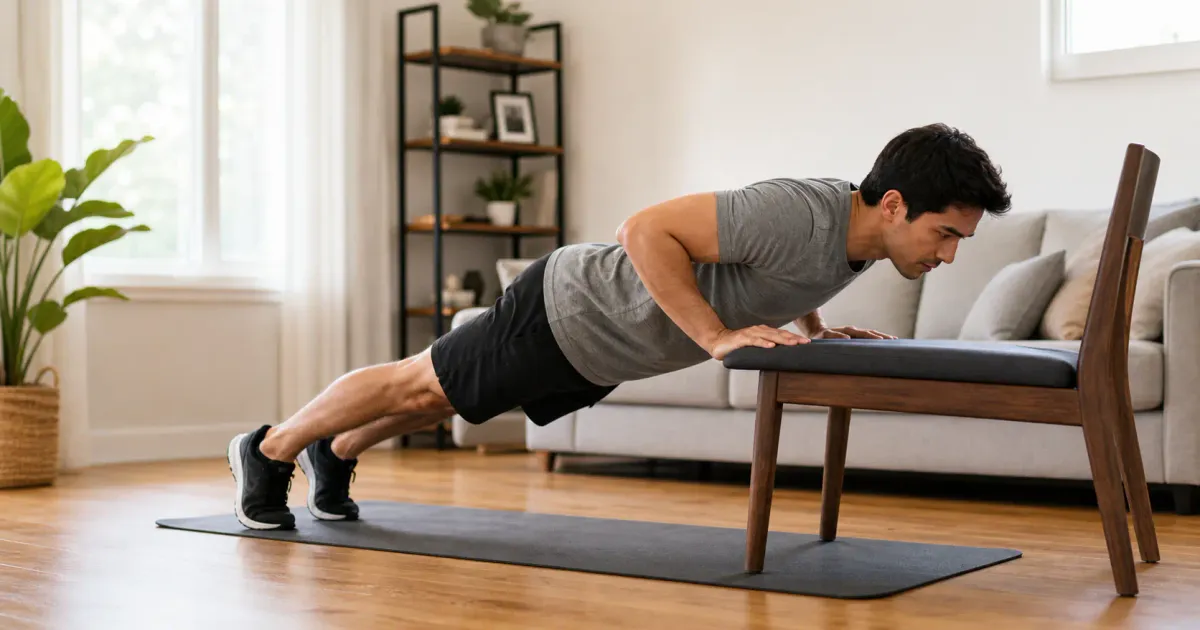
- Incline push-ups on a wall or table: 3 sets of 8
- Glute bridges: 3 sets of 12
- Plank: 3 rounds of 15 to 25 seconds
Rest for 45 to 75 seconds between sets. The goal is clean movement, not speed.
Day 2: Low-impact cardio
Walk briskly for 25 to 30 minutes. If you are indoors, use step-ups on a low step, marching in place, or a simple low-impact cardio video.
You should be breathing faster, but still able to speak in short sentences. That is a useful beginner intensity check.
Day 3: Strength repeat with small changes
- Reverse lunges or supported split squats: 3 sets of 8 each leg
- Knee push-ups or incline push-ups: 3 sets of 8
- Superman holds: 3 rounds of 20 seconds
- Dead bug: 3 rounds of 8 per side
Do not chase soreness. Mild muscle fatigue is fine. Sharp pain is a stop sign.
Day 4: Recovery movement
Recovery is not a wasted day. Do 20 to 30 minutes of easy walking, mobility, or stretching. This keeps the habit alive without making your body feel beaten up.
Day 5: Full body circuit
Complete 3 rounds:
- 10 squats
- 8 incline push-ups
- 12 glute bridges
- 20 seconds plank
- 30 seconds rest
Move steadily. If your form breaks, slow down or reduce reps.
How to progress after two weeks
Once the plan feels comfortable, change only one thing at a time:
- Add 2 reps per exercise.
- Add one extra set.
- Make the exercise slightly harder.
- Reduce rest by 10 seconds.
Small progress is easier to keep than sudden jumps.
Track the habit, not just the workout
Many beginners quit because they only measure weight. A better system is to track completed sessions, energy level, sleep, and how hard the workout felt.
In asterisks, you can log the workout, mark the day complete, and see whether your consistency is improving. That feedback is often more useful than waiting for visible body changes.
The plan is 30 minutes; the win is the calendar
Five days, one pattern: Monday full-body basics, Tuesday easy cardio (walk counts, proudly), Wednesday strength again with tiny variations, Thursday recovery movement, Friday the week’s circuit — weekends off without guilt. Any single day is unremarkable; five of them a week for two months is transformation-grade. Progress the boring way: two extra reps here, five slower seconds there, then harder variations. The plan’s real product isn’t fitness — it’s evidence. Eight weeks of checkmarks quietly rewrites identity from “trying to get fit” to “someone who trains at home,” and identity outlasts motivation every time.
That is the practical takeaway behind “beginner home workout plan”: start sensibly, then adjust from evidence.
Safety note
This is general fitness information, not medical advice. If you have an injury, chest pain, dizziness, pregnancy-related concerns, or a health condition, speak with a qualified professional before starting.
For general adult activity targets, the CDC in the US and the NHS in the UK both point adults toward regular weekly aerobic activity plus strength work. Use that as a long-term direction, not pressure for week one.