

Strength Training for Women Over 40: Beginner Plan
Starting strength training after 40 does not need to be extreme. Learn the benefits for menopause, bone density, metabolism, and a weekly plan.
Key Takeaways & Summary
Starting strength training after 40 does not need to be extreme. Learn the benefits for menopause, bone density, metabolism, and a weekly plan.
Macro & Recipe Nutrition Calculator
Calculate calories, protein, carbs, and fat per serving for home recipes.
A good “strength training women over 40” answer creates one actionable step. Extra facts can wait.
Strength Training After 40: The Beginner Plan Women Should Start With
There is a common misconception that strength training becomes less important as women age. The evidence points in exactly the opposite direction.
After 40, and especially through the perimenopause and menopause transition, strength training becomes one of the most useful investments in long-term health available. It helps preserve muscle mass, supports bone density, improves metabolic rate, and reduces the risk of several chronic conditions — including cardiovascular disease and type 2 diabetes.
This guide is for women who are new to lifting, returning after a break, or who want a clear, evidence-based starting framework — not an extreme program designed for competitive athletes.
Medical disclaimer: This article is for general educational purposes only. It is not medical advice. Consult a qualified healthcare professional before starting a new strength training program, particularly if you have any cardiovascular, joint, or bone health concerns.
Why Strength Training Matters After 40
Muscle Loss Accelerates With Age
Adults lose roughly 3–8% of muscle mass per decade after age 30, a process called sarcopenia. After menopause, the rate of loss can accelerate further due to declining estrogen levels. Muscle is metabolically active tissue — less of it means a lower resting metabolic rate and a greater tendency toward weight gain even without changes in diet.
Strength training is the most effective intervention to slow and partially reverse sarcopenia.
Estrogen Decline Affects Bone Density
Estrogen plays a significant role in maintaining bone density. As estrogen levels fall through perimenopause and menopause, the risk of osteoporosis increases substantially. The National Osteoporosis Foundation and the American College of Sports Medicine both recommend weight-bearing and resistance exercise as key tools for maintaining bone mineral density.
Metabolic Benefits
Building and maintaining lean muscle mass raises your basal metabolic rate — the number of calories your body burns at rest. This makes it easier to manage body composition without severe caloric restriction. Research also shows that resistance training improves insulin sensitivity, which is particularly important given the increased metabolic risk associated with the menopause transition.
Mental Health and Confidence
Multiple peer-reviewed studies have found significant reductions in depression and anxiety symptoms following regular resistance training programs. The sense of physical capability that comes from progressive strength training — noticing that you can lift more than you could three months ago — has a real and documented positive effect on confidence and mental wellbeing.
What Strength Training Looks Like After 40
You do not need to lift maximal weights, train like a competitive powerlifter, or spend two hours in the gym. The evidence supports a more moderate approach:
- 2–3 days per week of full-body strength training
- 8–12 repetitions per set for most exercises, in 2–3 sets
- Moderate weight — challenging but manageable with good form
- Progressive overload — gradually increasing weight or reps over time
- Compound movements as the foundation — exercises that work multiple muscle groups simultaneously
A full-body approach 2–3 days per week is generally recommended over split routines for beginners, because it provides sufficient stimulus for all major muscle groups while allowing adequate recovery time between sessions.
The Best Exercises for Women Over 40
Lower Body
Goblet Squat — Hold a dumbbell at chest height and squat until your thighs are parallel to the floor. This is a beginner-friendly alternative to a barbell squat that is easier on the lower back.
Romanian Deadlift — Hold dumbbells in front of your thighs, hinge at the hips, and lower the weights along your legs until you feel a stretch in the hamstrings. One of the most effective posterior chain exercises available.
Step-Up — Step onto a box or bench, drive through the heel, and stand tall at the top. Excellent for single-leg strength and hip stability.
Hip Hinge / Glute Bridge — Lie on your back, feet flat on the floor, and drive your hips toward the ceiling. Squeeze your glutes at the top. A highly accessible exercise with significant benefit for glute and hamstring strength.
Upper Body
Dumbbell Row — Place one hand and knee on a bench for support, pull a dumbbell from a hanging position to your hip. Works the lats, rhomboids, and biceps.
Push-Up (Modified or Full) — Modify by performing from the knees or with hands elevated on a bench if needed. Progress toward a full push-up over time.
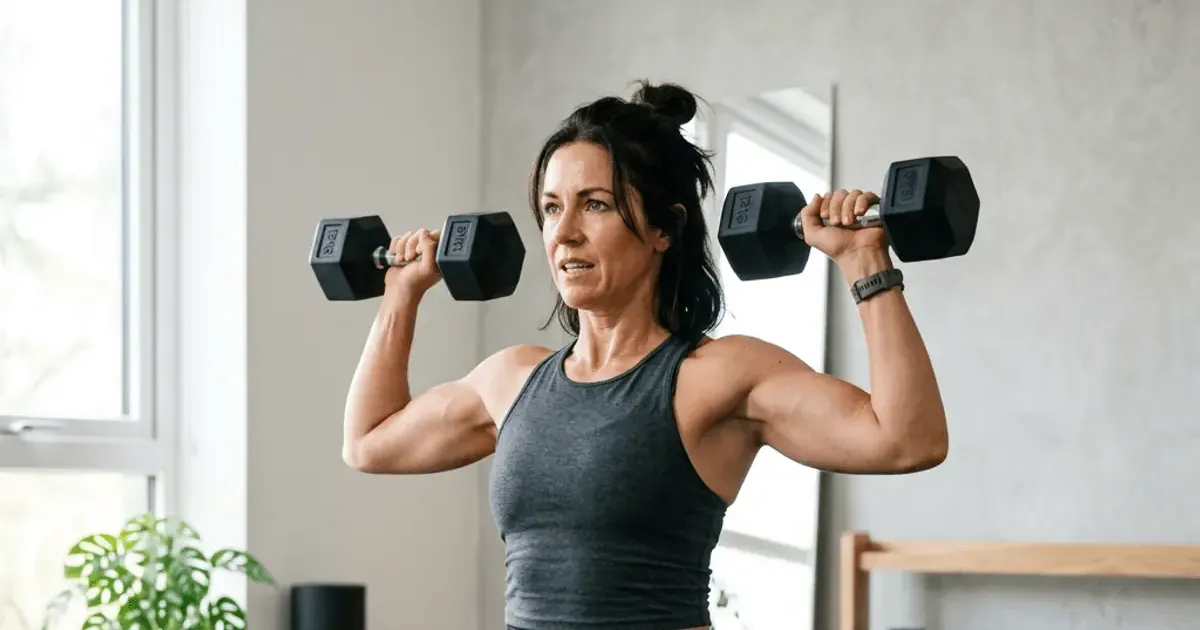
Overhead Press — Press dumbbells from shoulder height to directly overhead. Develops the deltoids, triceps, and upper back.
Chest Press — Lie on a bench or the floor, lower dumbbells to chest level, and press back up. Foundational upper body pressing movement.
Core
Dead Bug — Lie on your back with arms and legs raised. Slowly lower opposite arm and leg toward the floor while keeping your lower back pressed to the ground. Excellent for deep core stability.
Plank — Hold a forearm or straight-arm plank position. Begin with 20–30 second holds and build duration progressively.
Pallof Press — Attach a resistance band to a fixed point, stand sideways, and press the band straight out from your chest. Develops anti-rotation core stability.
Beginner 8-Week Weekly Training Plan
This plan uses 3 days of strength training per week with adequate rest days between sessions.
Equipment needed: A set of adjustable dumbbells or access to a basic gym. A bench (or sturdy chair) is helpful but optional.
Week 1–4: Foundation Phase
Session A (Monday / similar):
- Goblet squat: 3 × 10 reps
- Dumbbell row: 3 × 10 per side
- Hip hinge / glute bridge: 3 × 12 reps
- Overhead press: 3 × 10 reps
- Dead bug: 3 × 8 per side
Session B (Wednesday / similar):
- Romanian deadlift: 3 × 10 reps
- Push-up (modified or full): 3 × 8–12 reps
- Step-up: 3 × 10 per leg
- Chest press: 3 × 10 reps
- Plank: 3 × 20–30 seconds
Session C (Friday / similar):
- Repeat Session A with slightly heavier weight if Week 1 felt manageable
Rest / light walking: Tuesday, Thursday, Saturday, Sunday
Week 5–8: Progressive Overload Phase
In Weeks 5–8, apply progressive overload: increase the weight by the smallest available increment when you can complete all reps of a set with good form. Do not change the exercise selection — master the movements before adding complexity.
Also increase sets from 3 to 4 in the final two weeks for key exercises (squats, deadlifts, rows, press).
How Much Weight Should You Start With?
Choose a weight where:
- The last 2–3 reps of each set feel genuinely challenging.
- You can complete all reps with good form — no form breakdown, no holding your breath.
- You could not complete 3–4 more reps at the same weight comfortably.
This is sometimes called the “2 reps in reserve” principle. You are working hard, but not at maximum effort every set.
For most women new to strength training, this often means starting with 8–15 lb dumbbells for upper body exercises and 15–25 lb dumbbells for lower body exercises — but individual starting points vary considerably.
Nutrition for Strength Training After 40
Protein. Adequate protein intake is critical for muscle protein synthesis. Research suggests that women over 40 may benefit from somewhat higher protein intakes than younger adults, with recommendations generally falling between 0.6–1.0 gram of protein per pound of body weight per day. Prioritizing protein at every meal — eggs, Greek yogurt, legumes, chicken, fish, tofu — supports muscle recovery and maintenance.
Calcium and Vitamin D. Both are essential for bone health. Aim for adequate dietary calcium (approximately 1,000–1,200 mg per day for women over 50) and sufficient vitamin D. Discuss supplementation with your doctor if needed.
Calorie intake. Strength training is not most effective when combined with a large calorie deficit. If weight loss is a goal, aim for a moderate deficit (250–500 calories below maintenance) rather than severe restriction. Use the TDEE Calculator and Protein Calculator to estimate your targets.
Common Mistakes to Avoid
Skipping the warm-up. Warm joints move better and are less likely to get injured. Spend 5–10 minutes on light walking, arm circles, leg swings, and bodyweight squats before lifting.
Using weight that is too light. Many women initially choose weights that are far too easy to avoid “bulking up.” The evidence is clear: it takes deliberate, sustained effort over a long time for women to gain significant muscle mass. Using appropriately challenging weight is what drives the health benefits.
Skipping rest days. Muscle adaptation happens during recovery, not during the workout. Two rest days between lifting sessions is the minimum for beginners.
Inconsistency. Two to three months of consistent training is needed before most beginners see meaningful strength improvements. The program will not work if only attempted sporadically.
Ignoring pain signals. Muscle soreness after a session is normal. Sharp, joint-based, or persistent pain is not. Stop the exercise causing pain and consult a healthcare professional.
Frequently Asked Questions
Will strength training make me bulky?
No. Significant muscle hypertrophy (bulk) in women requires years of consistent progressive overload at high training volumes, typically with caloric surplus. Strength training for general fitness and health produces a lean, functional physique, not bodybuilder-level mass.
How long before I see results?
Most beginners notice improvements in strength, energy, and how clothes fit within 6–8 weeks. Visible changes in body composition typically become apparent around 3 months of consistent training.
Can I strength train during menopause?
Yes — and it is particularly beneficial during this period. Regular resistance training helps counteract the muscle and bone density loss associated with the estrogen decline of menopause.
Do I need a gym?
No. A pair of adjustable dumbbells, a resistance band set, and a yoga mat are enough to start a complete strength training program at home.
How does strength training help with menopause belly?
Hormonal changes during menopause tend to promote fat redistribution toward the abdomen. Strength training combats this by preserving muscle mass, improving insulin sensitivity, and supporting a healthier metabolic rate. It is not a spot-reduction method, but it is an effective part of a complete approach to body composition management.
Track Your Progress
Use these free tools from Asterisks Fit:
- BMR Calculator — understand your resting metabolic rate.
- TDEE Calculator — calculate your total daily calorie needs.
- Protein Calculator — find your daily protein target.
- Macro Calculator — plan your full nutrition targets.
Why the barbell beats the treadmill after 40
From the late 30s, muscle and bone density leave quietly unless something loads them — and walking, for all its virtues, doesn’t load much. Two or three strength sessions a week reverse more age-related decline than any cardio plan: stronger bones (loading is the signal), steadier joints, better blood sugar handling. Start with goblet squats, incline push-ups, and supported rows; add load slowly and treat protein like a prescription (1.6g/kg minimum). India’s longevity-training wave has finally made this mainstream — the weight room is anti-aging that actually holds up in research.
Keep “strength training women over 40” practical. Avoid all-or-nothing targets.