

Pilates Strength Workout at Home: Core & Control Plan
A beginner-friendly way to combine Pilates-style control with simple resistance training for a stronger home workout routine.
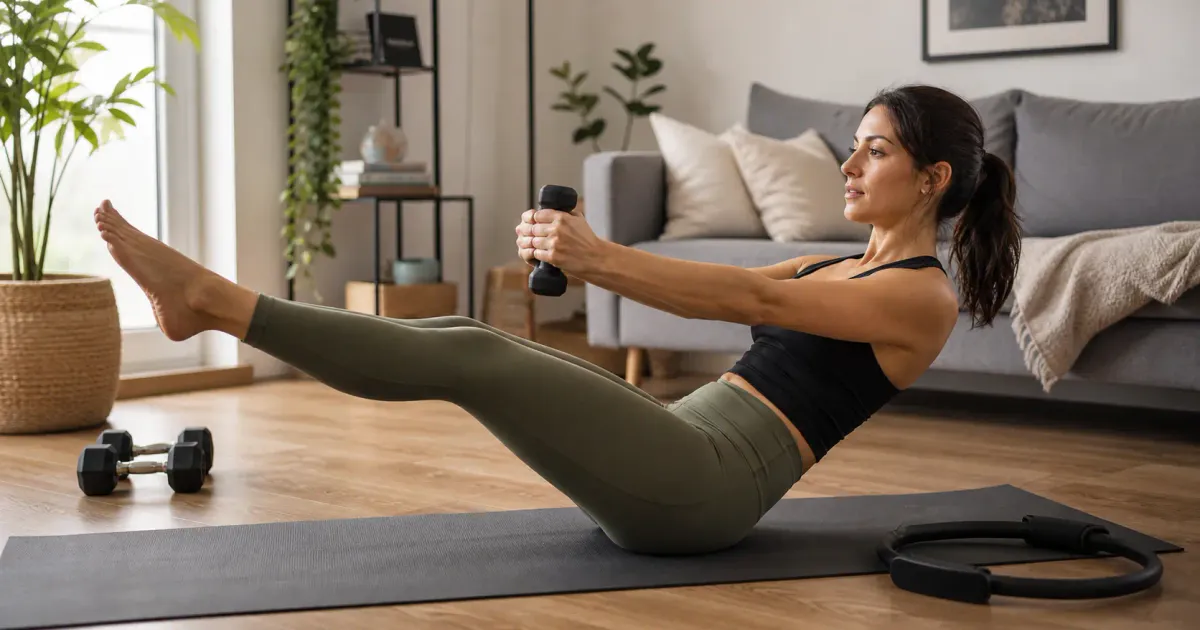
Key Takeaways & Summary
A beginner-friendly way to combine Pilates-style control with simple resistance training for a stronger home workout routine.
Pilates-style workouts are trending because they feel controlled, focused, and joint-friendly. Strength training is trending because muscle matters. The useful middle ground is a routine that borrows from both.
The useful part of “pilates strength workout home” is choosing the next adjustment. Ignore perfect answers.
Pilates strength fusion means slow reps, clean positions, core control, and enough resistance to actually build strength.
What you need
Start with a mat and one of these:
- A pair of light dumbbells
- A resistance band
- A loaded backpack
- Your bodyweight
The tool matters less than the intent. Move slowly, keep tension, and progress over time.
The 30-minute home session
Do this two or three times per week.
Warm-up
- Cat-cow: 6 reps
- Hip circles: 6 each side
- Glute bridge: 10 reps
- Dead bug: 6 each side
Main work
- Slow squat: 3 sets of 10
- Push-up or incline push-up: 3 sets of 6 to 10
- Single-leg glute bridge: 3 sets of 8 each side
- Band row or backpack row: 3 sets of 10
- Side plank: 2 rounds each side
Finisher
- Pilates hundred variation: 30 to 45 seconds
- Bodyweight good morning: 12 reps
- Tall-kneeling overhead press: 10 reps
Repeat the finisher twice.
Slow does not mean easy
Use a three-second lowering phase on squats, push-ups, and rows. Pause for one second where the movement is hardest. This creates more time under tension without needing heavy weights.
How to progress
Every week, improve one detail:
- Add two reps.
- Use a stronger band.
- Add a set.
- Slow the lowering phase.
- Improve range of motion.
Progress should be visible in your notes, not just in how sweaty you feel.
Keep the Pilates part honest
The core work is not about flattening your stomach in one session. It is about controlling your ribs, pelvis, breath, and spine while your limbs move.
That control carries into lifting, walking, running, and daily posture.
Why Pilates-plus-strength beats either alone
Pure Pilates builds control without much load; pure lifting builds load without much control — the fusion covers each one’s blind spot. A working home week: two strength days (squats, push-ups, rows with whatever weight exists) and two Pilates-style days (dead bugs, bird dogs, hundreds, slow bridges) — the second pair teaching the ribs-down, core-braced position the first pair spends. Urban India’s “balance and flow” wave has made this pairing mainstream for desk workers, and deservedly: the strength work fights weakness, the control work fights the chair. Both enemies deserve attention.
Start with this “pilates strength workout home” framework. Refine it from outcomes.