

Walking Pad Weight Loss: Daily Plan That Actually Works
Learn the walking pad speeds, times, calorie estimates, and simple weekly routine that make under-desk walking easier to keep.
Key Takeaways & Summary
Learn the walking pad speeds, times, calorie estimates, and simple weekly routine that make under-desk walking easier to keep.
Steps to Calories & Distance Calculator
Convert daily step counts into miles, kilometers, and total calories burned.
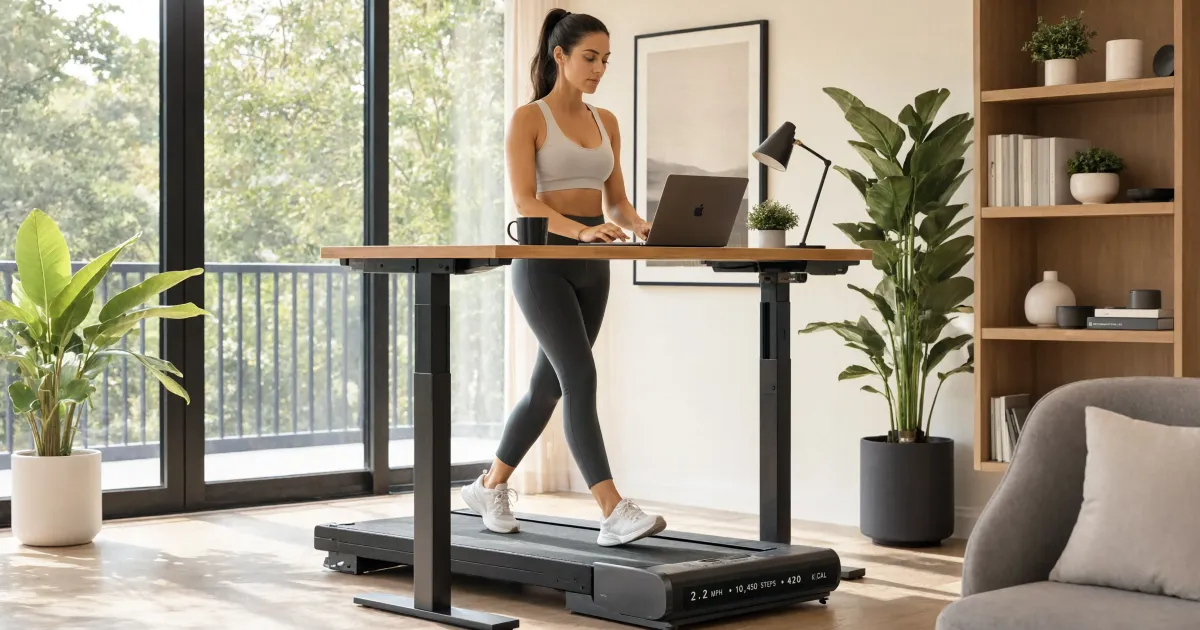
A walking pad sits under your desk and lets you walk while you work. That is the whole pitch. No commute to the gym, no changing clothes, no blocked calendar slot — just consistent, low-impact movement built into your existing day.
For “walking pad weight loss,” perfection is unnecessary. Make the next decision easier.
For many people, the walking pad has become the most realistic piece of fitness equipment they own. And from a weight loss perspective, that matters more than almost any other metric.
This guide covers what the research says about walking pads for weight loss, the speeds and durations that make a difference, calorie burn estimates, and a practical weekly routine you can actually stick to.
Medical disclaimer: This article is for general educational purposes only. It is not medical advice. Consult a qualified healthcare professional before starting a new exercise program, especially if you have joint pain, cardiovascular concerns, or balance issues.
What Is a Walking Pad?
A walking pad (sometimes called a walking treadmill or under-desk treadmill) is a compact, flat treadmill belt designed for slow to moderate walking speeds. Most models reach a maximum speed of 3.5–6 mph, have a low profile for under-desk use, and fold flat for storage.
Unlike traditional treadmills, walking pads are built primarily for non-exercise activity thermogenesis — the calories you burn through movement outside of dedicated workouts. Think of it as turning your seated work hours into active ones.
Walking Pad vs. Treadmill: Key Differences
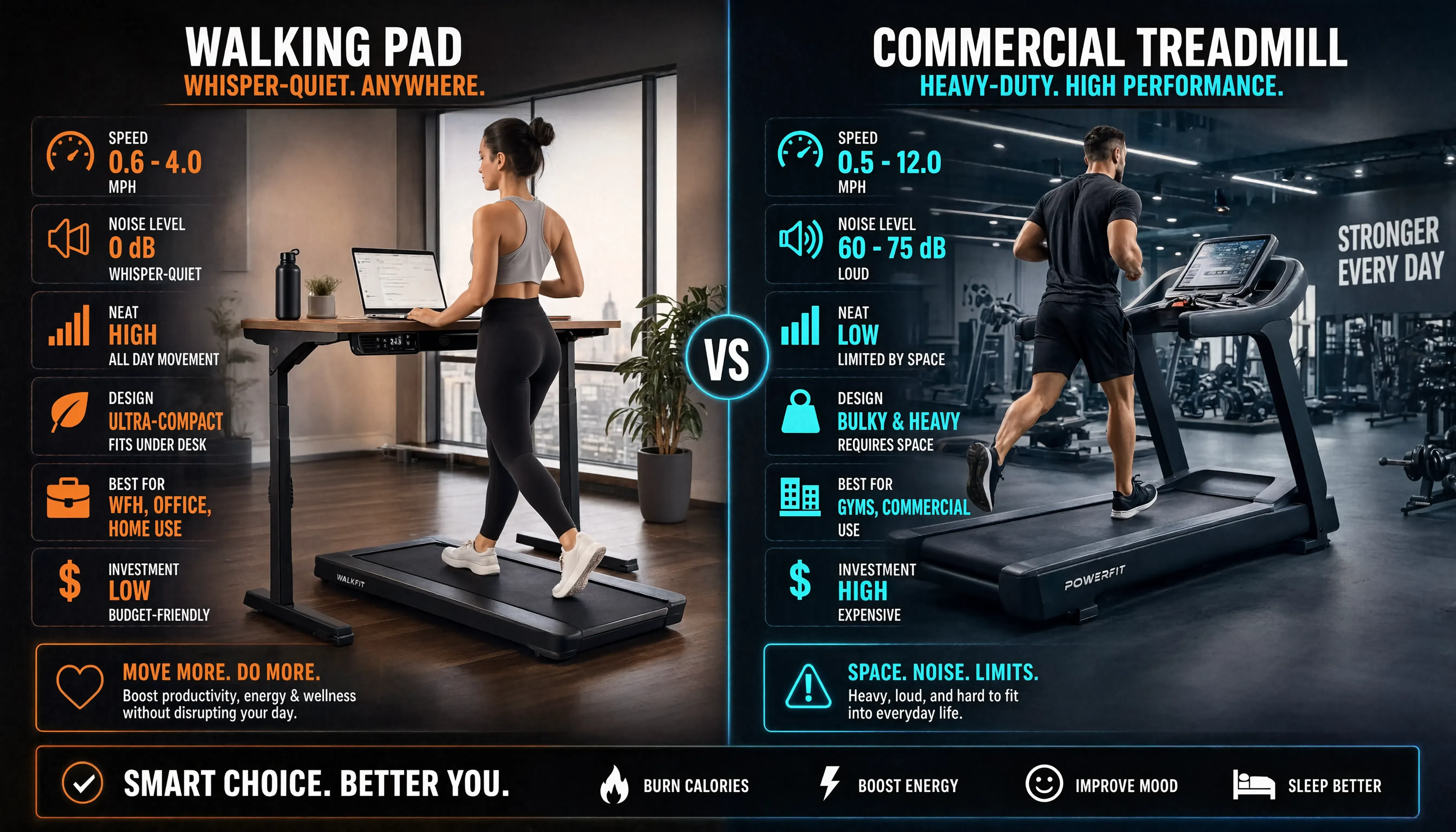
| Feature | Walking Pad (Under-Desk) | Traditional Treadmill |
|---|---|---|
| ⚡ Maximum speed | 3.5–6.0 mph (walking focus) | 10–15 mph (sprints & running) |
| 📐 Incline options | Rare; mostly flat design | Common (0% to 15% motorized) |
| 📦 Size & portability | Compact, ultra-thin, foldable | Large, heavy, fixed footprint |
| 💼 Primary use case | Walking while typing & meetings | Dedicated high-intensity cardio |
| 💰 Price range | $200–$600 (₹15k–₹35k) | $600–$3,000+ (₹50k–₹2.5L) |
| 🔇 Noise level | Whisper quiet (< 45 dB) | Louder high-RPM motor |
If your goal is steady-state walking to accumulate movement and support a calorie deficit, a walking pad does the job. If you want to run, do intervals, or train at incline, a traditional treadmill is the better fit.
How Many Calories Does a Walking Pad Burn?
Calorie burn depends on your body weight, walking speed, and duration. The estimates below are approximate, based on MET (metabolic equivalent of task) values from the American College of Sports Medicine:
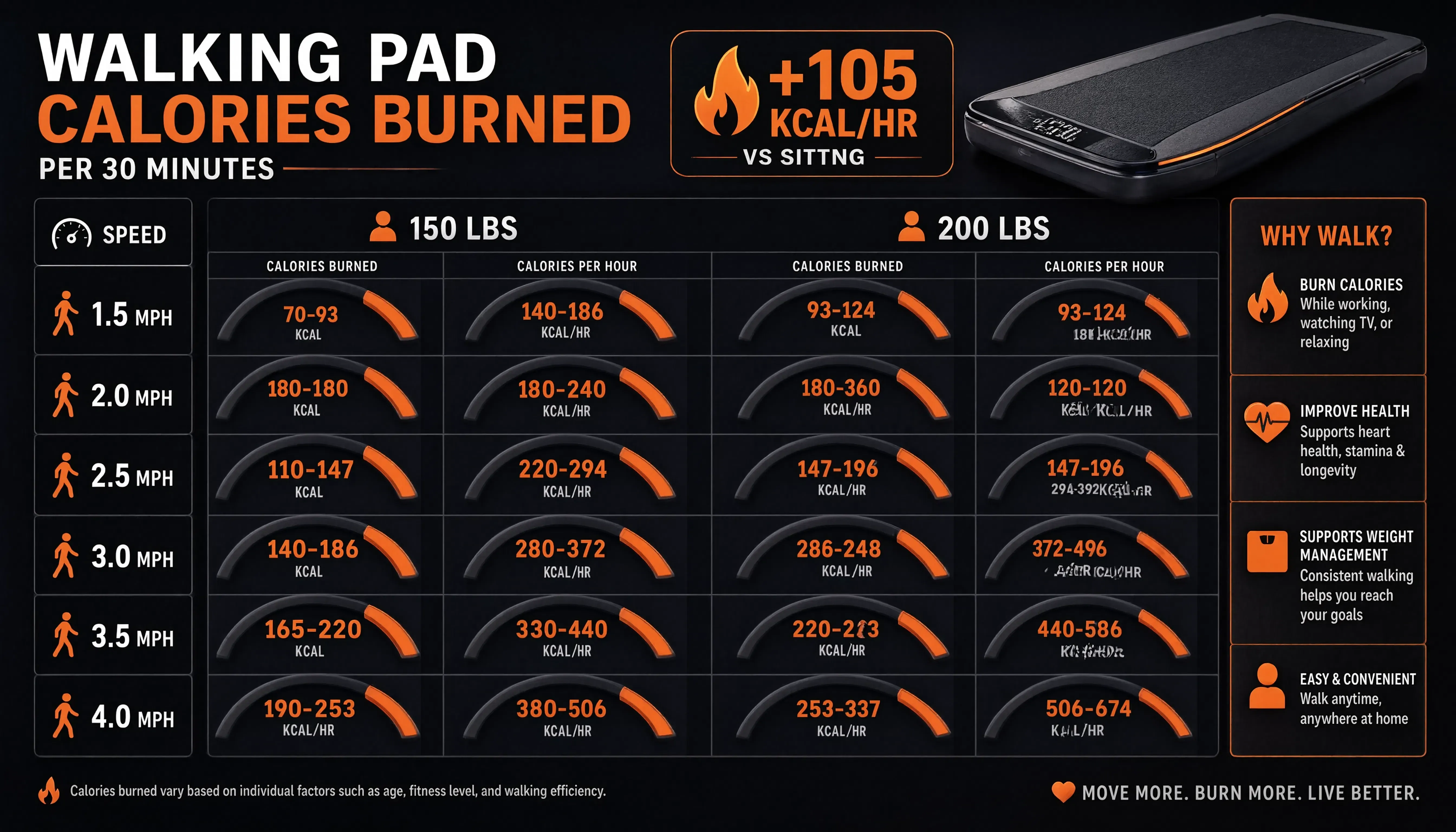
| Speed | Pace Description | 150 lb (68 kg) / 30 min | 200 lb (91 kg) / 30 min |
|---|---|---|---|
| 🚶 1.5 mph | Very slow, leisurely typing | ~70 kcal | ~93 kcal |
| 🚶 2.0 mph | Slow under-desk sweet spot | ~90 kcal | ~120 kcal |
| 🚶 2.5 mph | Comfortable active work pace | ~110 kcal | ~147 kcal |
| 🚶 3.0 mph | Moderate brisk walk | ~140 kcal | ~186 kcal |
| 🚶 3.5 mph | Brisk cardio walk | ~165 kcal | ~220 kcal |
| 🚶 4.0 mph | Fast power walk | ~190 kcal | ~253 kcal |
Values are approximate and will vary based on your individual physiology.
Research suggests that walking at a desk increases energy expenditure by approximately 100–105 extra calories per hour compared to sitting. Over a 4-hour work session, that adds up to 400+ additional calories — without any dedicated workout time.
Best Walking Pad Speed for Weight Loss
The most common question about walking pads is which speed to use. The answer depends on what you are doing while you walk:
- While working (typing, reading, video calls): 1.8–2.5 mph is the practical sweet spot. Fast enough to add meaningful movement, slow enough to type accurately and stay focused.
- During a dedicated cardio session (not working): 3.0–4.0 mph will elevate your heart rate into a moderate aerobic zone and burn significantly more calories per minute.
- For beginners: Start at 1.5–2.0 mph during work hours for the first 1–2 weeks. Your body and your typing will both need to adapt.
The most important speed is the one you can sustain consistently for longer periods. A two-hour walk at 2.0 mph burns more total calories than a 20-minute walk at 4.0 mph that you cannot replicate tomorrow.
How Long Should You Use a Walking Pad Each Day?
The Department of Health and Human Services recommends at least 150 minutes of moderate-intensity aerobic activity per week for general health. A walking pad can realistically contribute most or all of that — and the under-desk format makes accumulating those minutes far easier than carving out gym time.
Practical targets by goal:
| Goal | Daily Walking Pad Target | Expected Calorie Burn |
|---|---|---|
| 🎯 General health maintenance | 60–90 minutes at 2.0–2.5 mph | ~180–250 kcal |
| ⚡ Weight loss support | 90–120 minutes at 2.0–3.0 mph | ~300–450 kcal |
| 🔥 Accelerated calorie burn | 45–60 min dedicated session at 3.5–4.0 mph | ~250–400 kcal |
| 🔰 Beginner (first 2 weeks) | 30–45 minutes split across morning & afternoon | ~100–150 kcal |
You do not need to do all your walking at once. Walking for 30 minutes in the morning, 30 minutes in the afternoon, and 30 minutes in the evening all count.
Sample Walking Pad Workout Week
This plan balances under-desk walking with two dedicated workout sessions:
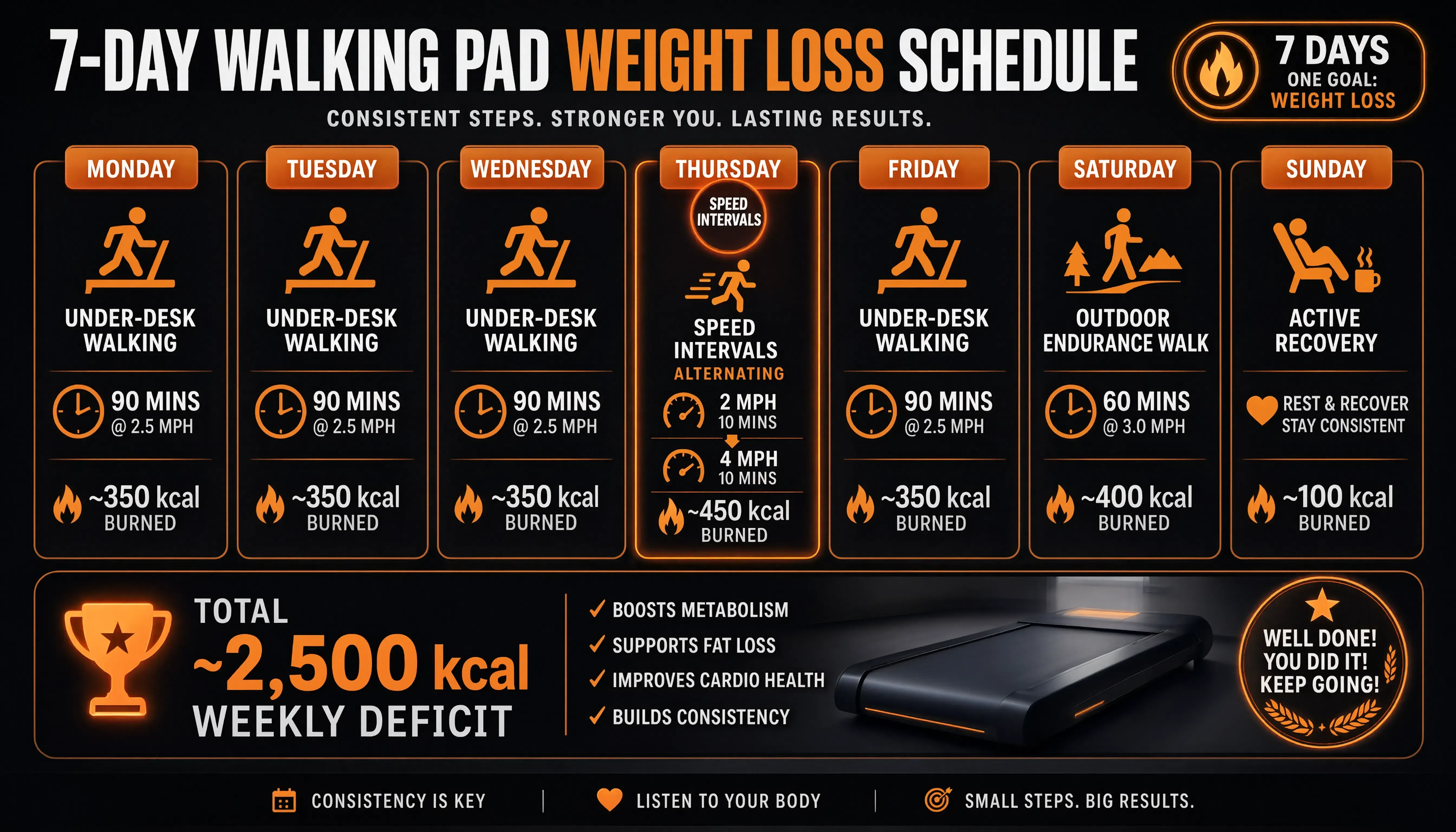
| Day | Activity Type | Duration | Speed Range |
|---|---|---|---|
| 📅 Monday | Under-desk walking (work hours) | 90 min | 2.0–2.5 mph |
| 📅 Tuesday | Dedicated brisk walk + under-desk | 30 min + 60 min | 3.5 mph / 2.0 mph |
| 📅 Wednesday | Under-desk walking (split sessions) | 90 min | 2.0–2.5 mph |
| 📅 Thursday | Dedicated interval walk + under-desk | 30 min + 60 min | Alternating 2.0 & 4.0 mph / 2.0 mph |
| 📅 Friday | Under-desk walking | 90 min | 2.0–2.5 mph |
| 📅 Saturday | Longer outdoor or dedicated walk | 45–60 min | 3.0–4.0 mph |
| 📅 Sunday | Rest & active light recovery | — | — |
Interval walking protocol (Thursday): Walk at 3.0 mph for 2 minutes, increase to 4.0 mph for 1 minute, repeat for 30 minutes. This raises heart rate and burns more calories than steady-state walking alone.
Walking Pad Tips for Weight Loss
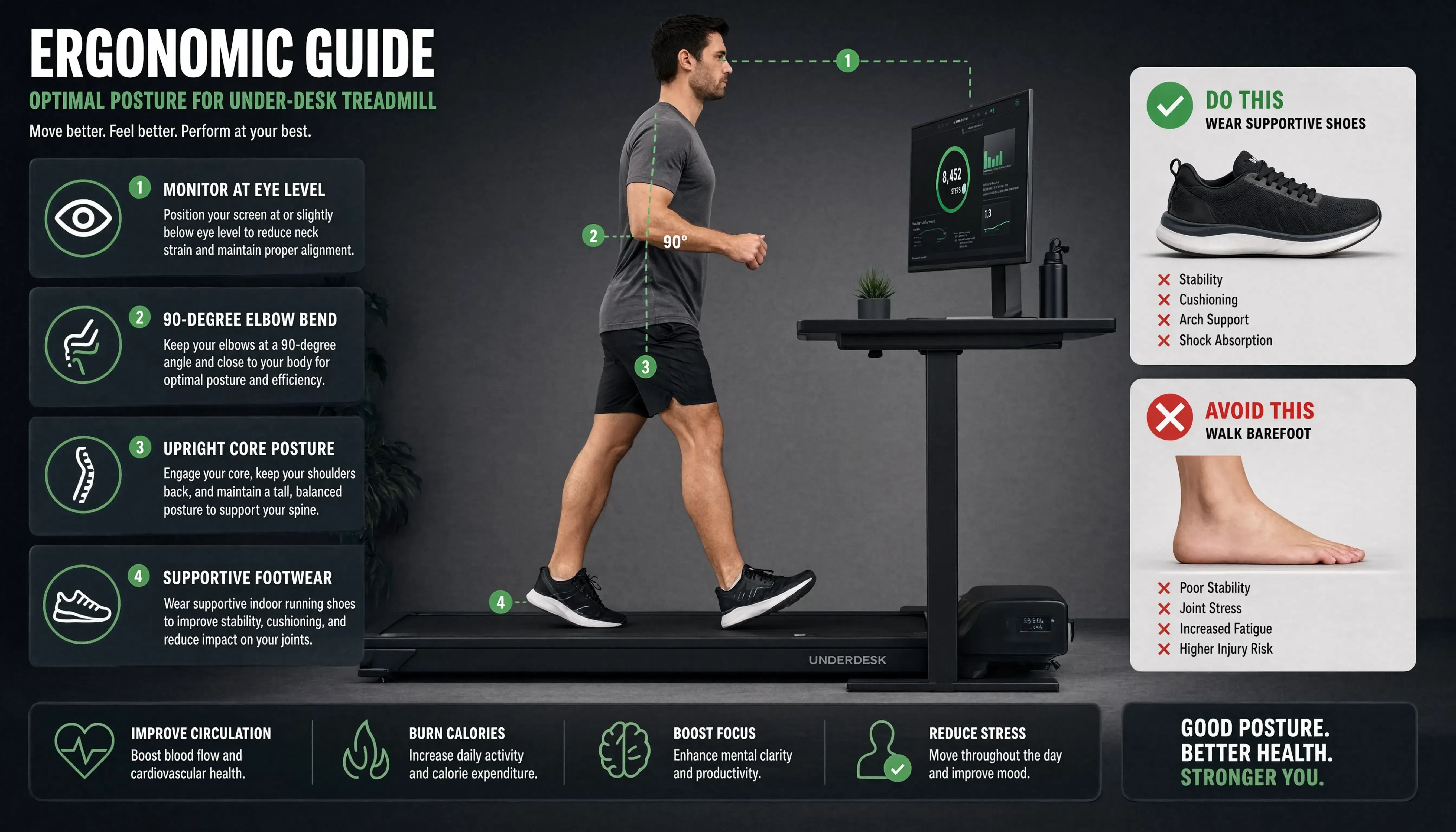
Wear proper footwear. Walking barefoot or in socks on a moving belt for extended periods can cause plantar fasciitis and joint discomfort. Wear supportive athletic shoes even indoors.
Set your desk height correctly. Your screen should be at eye level and your keyboard at elbow height. Poor ergonomics leads to neck and shoulder strain that will make you stop using the pad.
Do not compensate with food. It is easy to overestimate how many calories you burn during low-intensity walking and eat them back. A 90-minute under-desk session at 2 mph burns roughly 200–300 calories depending on your weight — not enough to justify a significantly larger meal.
Track your steps. A step counter, fitness tracker, or phone health app lets you see cumulative daily movement. Many walking pad users find that aiming for 8,000–12,000 steps per day is a useful and motivating target.
Combine with a calorie deficit. Walking pads contribute to weight loss by increasing total daily energy expenditure. The calorie deficit that drives fat loss still needs to come from the combination of movement and food intake. Use the Calorie Deficit Calculator to find your target.
Walking Pad for NEAT (Non-Exercise Activity Thermogenesis)
NEAT — the calories burned through all movement that is not formal exercise — is one of the most overlooked factors in weight management. For sedentary desk workers, NEAT can be dramatically low.
A walking pad directly addresses this by converting passive sitting time into active walking time. Research into under-desk treadmill use has shown that the cumulative effect of several hours of slow walking can rival the calorie burn of a dedicated workout session, with significantly lower injury risk.
For more on NEAT and how it affects your total calorie expenditure, see the TDEE Calculator and the blog article on NEAT and non-exercise activity.
Common Walking Pad Mistakes
Walking at an uncomfortable speed while trying to work. This leads to poor posture, typing errors, and frustration. Start slower than you think you need to.
Using it only for a few days and stopping. The walking pad’s power is in accumulation over weeks and months. Consistency matters more than any single session.
Ignoring posture. Leaning forward, holding the desk for balance, or looking down at the belt all cause strain. Walk tall with your core lightly engaged.
Expecting the pad to do the work alone. Diet, sleep, stress management, and overall activity all matter. A walking pad is a powerful tool in a complete approach, not a standalone solution.
Frequently Asked Questions
Does a walking pad really help with weight loss?
Yes, when used consistently. A walking pad increases your total daily energy expenditure — particularly NEAT — which contributes to the calorie deficit needed for weight loss. The key is sustained, consistent use rather than occasional sessions.
What speed should I walk on a walking pad to burn fat?
Any walking speed burns fat as a fuel source. A speed of 2.5–3.5 mph during a dedicated session will produce meaningful calorie burn while remaining sustainable. While working, 2.0–2.5 mph is more practical.
How long should I walk on a walking pad each day to lose weight?
Aim for at least 90 minutes of total daily walking across work and dedicated sessions. This is achievable in small increments — 30 minutes three times per day is equivalent.
Can I use a walking pad while on video calls?
Many people do. Walking slowly at 1.5–2.0 mph typically does not affect your voice or cause noticeable movement on camera. Test with the speed lower before an important call.
Is a walking pad worth it for weight loss?
For people who work from home or have sedentary desk jobs, a walking pad is one of the most practical ways to add consistent movement without changing your schedule. Its value is in daily, long-term use rather than intensity.
Calculate Your Walking Calories
Use these free Asterisks Fit tools to put your walking pad plan into numbers:
- Walking Calorie Calculator — estimate calories burned based on your weight, speed, and duration.
- Calories Burned Calculator — compare different activities and intensities.
- Weight Loss Timeline Calculator — see how your daily walking contributes to your weight goal over time.
- TDEE Calculator — understand your full daily energy expenditure.
The math that makes a walking pad worth it
At 4 km/h during calls, an hour on the pad burns roughly 200-250 calories for a 70kg person. Do that during just two meetings a day and you’ve added ~450 calories of output without “working out” once. That’s the entire pitch — it converts dead meeting time into movement. Buy the flat kind without handles (₹15,000-25,000 in India covers a decent one), keep it at walking speeds, and don’t try to type during anything above 3.5 km/h. It won’t replace strength training; it will quietly erase the WFH weight creep.
Apply the “walking pad weight loss” principle.