

Full-Body Dumbbell Workout for Beginners (6 Moves)
A simple dumbbell workout for beginners who want to train the whole body with a clear plan, safe effort, and easy progression.
Key Takeaways & Summary
A simple dumbbell workout for beginners who want to train the whole body with a clear plan, safe effort, and easy progression.
Dumbbells are useful because they are simple, flexible, and easy to scale. You can train at home or in the gym without learning dozens of machines.
Ignore the noise around “dumbbell workout for beginners.” Keep only usable steps.
This beginner workout uses basic movement patterns: squat, hinge, push, pull, and core.
What you need
You need:
- One pair of light or moderate dumbbells
- A mat or clear floor space
- 30 to 40 minutes
- A way to record sets and reps
Choose a weight that lets you move with control. You should finish most sets with 2 or 3 good reps still available.
Five-minute warm-up
Before the first working set, use a short warm-up: easy marching or jumping jacks, arm circles, bodyweight squats, and one light practice set of the first two exercises. The aim is to raise your temperature and rehearse the movements, not tire yourself out.
The workout
Do this 2 or 3 times per week with at least one rest day between sessions.
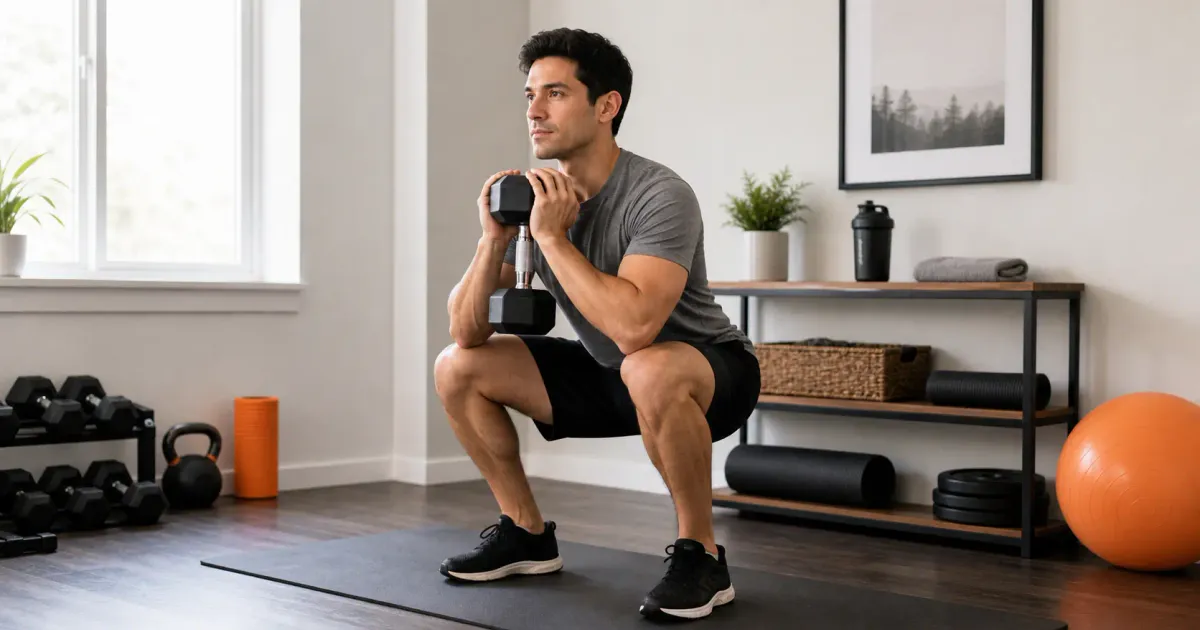
1. Goblet squat
Do 3 sets of 8 to 10 reps.
Hold one dumbbell close to your chest. Sit down between your hips, keep your chest tall, and push through the floor to stand.
2. Dumbbell Romanian deadlift
Do 3 sets of 10 reps.
Hold the dumbbells in front of your thighs. Push your hips back, keep your back neutral, and feel the stretch in your hamstrings. Stand up by squeezing your glutes.
3. Dumbbell floor press
Do 3 sets of 8 to 10 reps.
Lie on the floor, press the dumbbells up, and lower until your upper arms touch the floor gently. This is a beginner-friendly pressing option because the floor limits range.
4. One-arm dumbbell row
Do 3 sets of 10 each side.
Support one hand on a bench, chair, or sturdy surface. Pull the dumbbell toward your ribs without twisting your body.
5. Dumbbell shoulder press
Do 2 sets of 8 reps.
Press overhead with control. If your lower back arches, use lighter dumbbells or do the exercise seated.
6. Dead bug
Do 3 sets of 8 each side.
Move slowly and keep your lower back controlled. This builds core stability without needing endless crunches.
Optional accessory work
The six main movements already cover the whole body. If you have time and recover well, add one or two optional exercises after them:
- Reverse lunges: 2 sets of 8 per leg
- Dumbbell curls: 2 sets of 10 to 12
- Overhead triceps extensions: 2 sets of 10 to 12
Accessories should not replace the squat, hinge, press, and row patterns or make the session too long to repeat.
How to progress
Use one simple progression at a time:
- Add 1 rep per set.
- Add one extra set to one exercise.
- Use slightly heavier dumbbells.
- Slow down the lowering phase.
Do not increase weight if your form becomes messy.
Track your session
Log the exercises, weights, reps, and difficulty in asterisks. The next time you train, you will know whether to repeat, add reps, or increase weight.
One pair of dumbbells, three months of progress
Six moves cover everything: goblet squat, Romanian deadlift, floor press, one-arm row, overhead press, farmer’s carry. Three rounds of 10-12, three days a week, done inside 40 minutes. A pair of adjustable dumbbells (₹3,000-6,000 in India) outlasts most gym memberships — and the farmer’s carry at the end is quietly the 2026 longevity trend hiding in a beginner plan. When 12 reps feel conversational, the dumbbell gets heavier or the tempo gets slower. Simple scales; complicated stalls.
For “dumbbell workout for beginners,” consistent practice beats a flawless start.
Safety note
This workout is general information, not medical advice. Stop if you feel sharp pain, dizziness, or unusual discomfort. Ask a qualified trainer for form help if needed.