

Running Calories per Km: Calculator by Body Weight
Estimate calories burned running per kilometer by body weight, pace and incline, and learn when a running calorie calculator is more accurate.

Key Takeaways & Summary
Estimate calories burned running per kilometer by body weight, pace and incline, and learn when a running calorie calculator is more accurate.
Steps to Calories & Distance Calculator
Convert daily step counts into miles, kilometers, and total calories burned.
A useful running calorie shortcut is about 1 kcal per kg of body weight per kilometer. That means a 70 kg runner burns roughly 70 kcal per km, 350 kcal for 5 km, and 700 kcal for 10 km.
This shortcut is not perfect, but it is fast. For a more detailed estimate, use the Running Calorie Calculator with your weight, pace, distance, and duration.
Running calories per km chart
Approximate calories burned using the 1 kcal per kg per km rule:
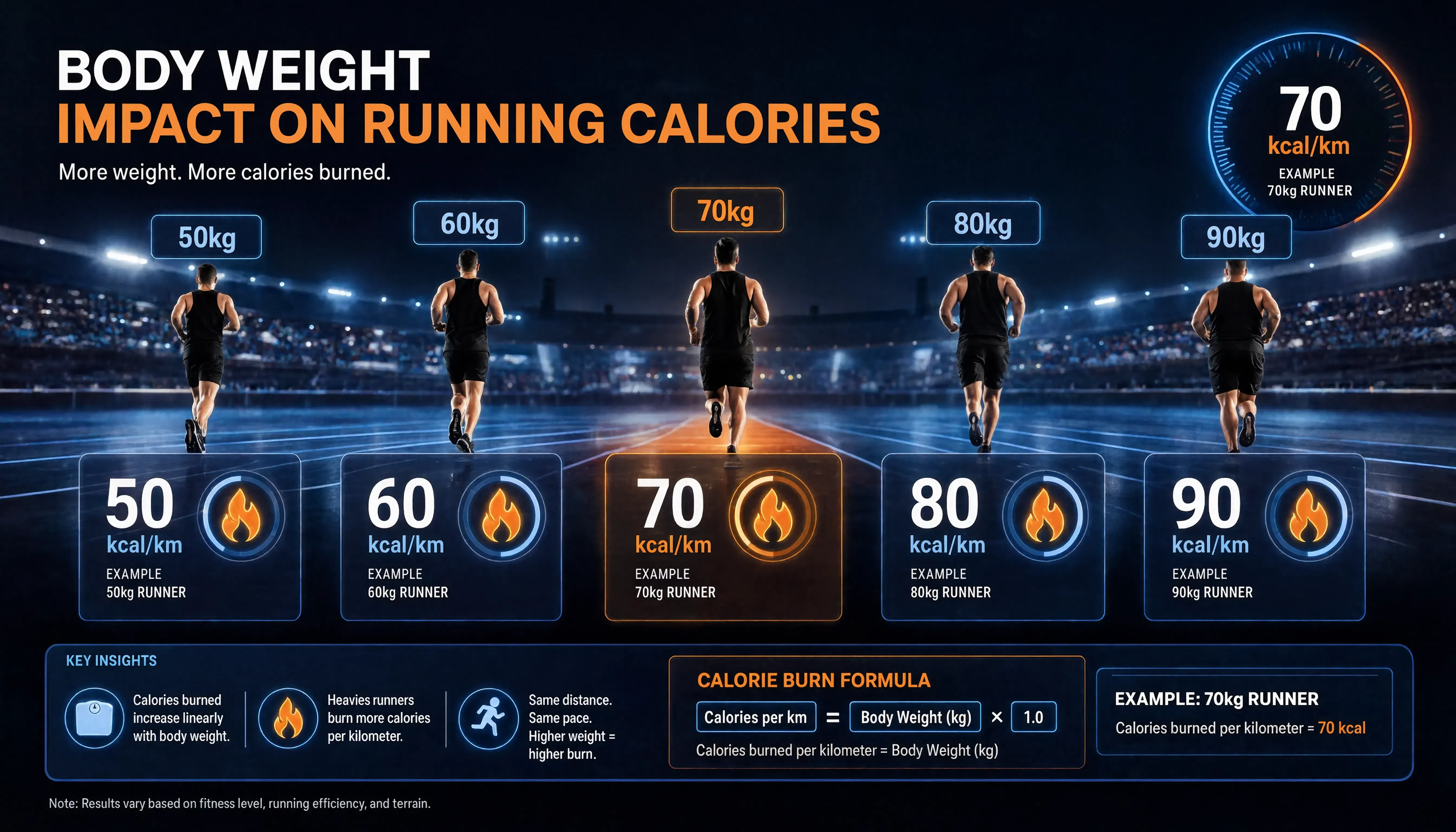
| Body Weight | 1 km | 5 km | 10 km | Half Marathon (21.1 km) |
|---|---|---|---|---|
| 🏃 50 kg | 50 kcal | 250 kcal | 500 kcal | 1,055 kcal |
| 🏃 60 kg | 60 kcal | 300 kcal | 600 kcal | 1,266 kcal |
| 🏃 70 kg | 70 kcal | 350 kcal | 700 kcal | 1,477 kcal |
| 🏃 80 kg | 80 kcal | 400 kcal | 800 kcal | 1,688 kcal |
| 🏃 90 kg | 90 kcal | 450 kcal | 900 kcal | 1,899 kcal |
The estimate works best for steady running on mostly flat ground. Treadmill incline, hills, trail surfaces, wind, and inefficient pacing can change the final number.
Does running pace matter?
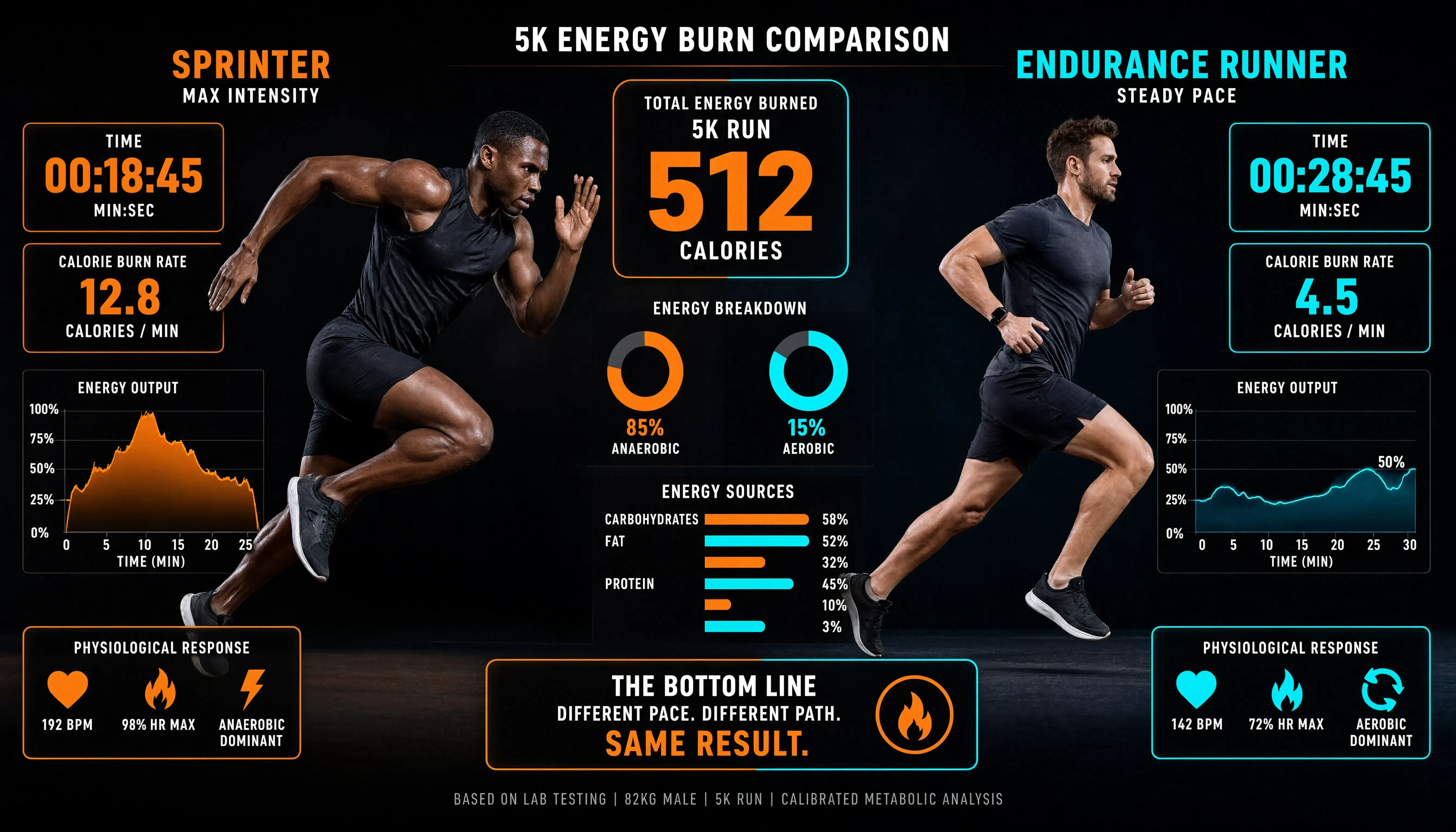
Pace changes how many calories you burn per minute. A faster runner covers the distance sooner, while a slower runner spends more time moving. For the same distance, body weight and distance explain a large part of the total calorie burn.
If your goal is training performance, pair calories with pace using the Running Pace Calculator.
Running calories versus walking calories
Running usually burns more calories per minute than walking because the intensity is higher. Per kilometer, the difference can be smaller than people expect, especially when comparing running with brisk incline walking.

The better choice depends on your joints, recovery, time, and goal. Walking is easier to repeat often. Running is time-efficient but needs more recovery management.
How to use running calories for fat loss
Do not treat running calories as a perfect food budget. Calorie calculators and watches can overestimate, and appetite can rise after hard sessions.
A better approach:
- Pick a weekly running distance you can recover from.
- Keep easy runs easy so the plan is repeatable.
- Track average body weight over two to four weeks.
- Adjust food intake or weekly distance gradually.
Race-distance examples
For a 70 kg runner:
- 5 km: about 350 kcal
- 10 km: about 700 kcal
- Half marathon: about 1,477 kcal
- Marathon: about 2,953 kcal

For race planning, use calories mainly for fueling context. Use the Race Time Predictor when your main question is pacing or finish time.
Common mistakes to avoid
- Eating back every calorie shown on a watch.
- Ignoring hills, trail surfaces, heat, and fatigue.
- Increasing weekly distance too quickly.
- Comparing running calories between people with different body weights.
- Using running calorie estimates as a substitute for injury or medical guidance.
FAQs
How many calories does running 5 km burn?
A rough estimate is body weight in kg multiplied by 5. A 70 kg runner burns about 350 kcal for 5 km.
How many calories does running 10 km burn?
Use body weight in kg multiplied by 10. A 70 kg runner burns about 700 kcal for 10 km.
Does treadmill running burn fewer calories?
It can be similar if speed and effort match, but treadmill incline, belt mechanics, and holding the rails can change the estimate.
The clean rule: 1 calorie per kg per km
Running’s beautiful arithmetic: roughly one calorie per kilogram of body weight per kilometre, almost regardless of pace. A 70kg runner spends ~70 calories each km — 350 for a 5K, 700 for a 10K — whether it’s a proud sprint or an honest shuffle; pace changes the time bill, not the energy bill much. The sobering half: that hard-earned 5K equals one plate of pav bhaji, minus the pav. Which is the entire lesson — run for the heart, the mood, and the engine; settle the weight-loss account in the kitchen, where the exchange rates are better.